A Data Engineer’s View on ML: The Hype Changes, But the Data Doesn't
For the last two years, I haven't been following the mainstream AI and ML hype cycle all that closely. I've been deep in the trenches of core data engineering—building infrastructure, stabilizing pipelines, and ensuring data reliability.
When you step away from the daily flood of tech headlines and look at what is actually delivering value in production, you notice something interesting. The industry keeps moving toward shinier, more complex algorithms, yet the actual success of those models still hinges on the exact same foundation: good old-fashioned data quality.
Here are a few observations from a data-first perspective on where ML stands today.
1. From Random Forests to XGBoost (and the Return to Statistics)
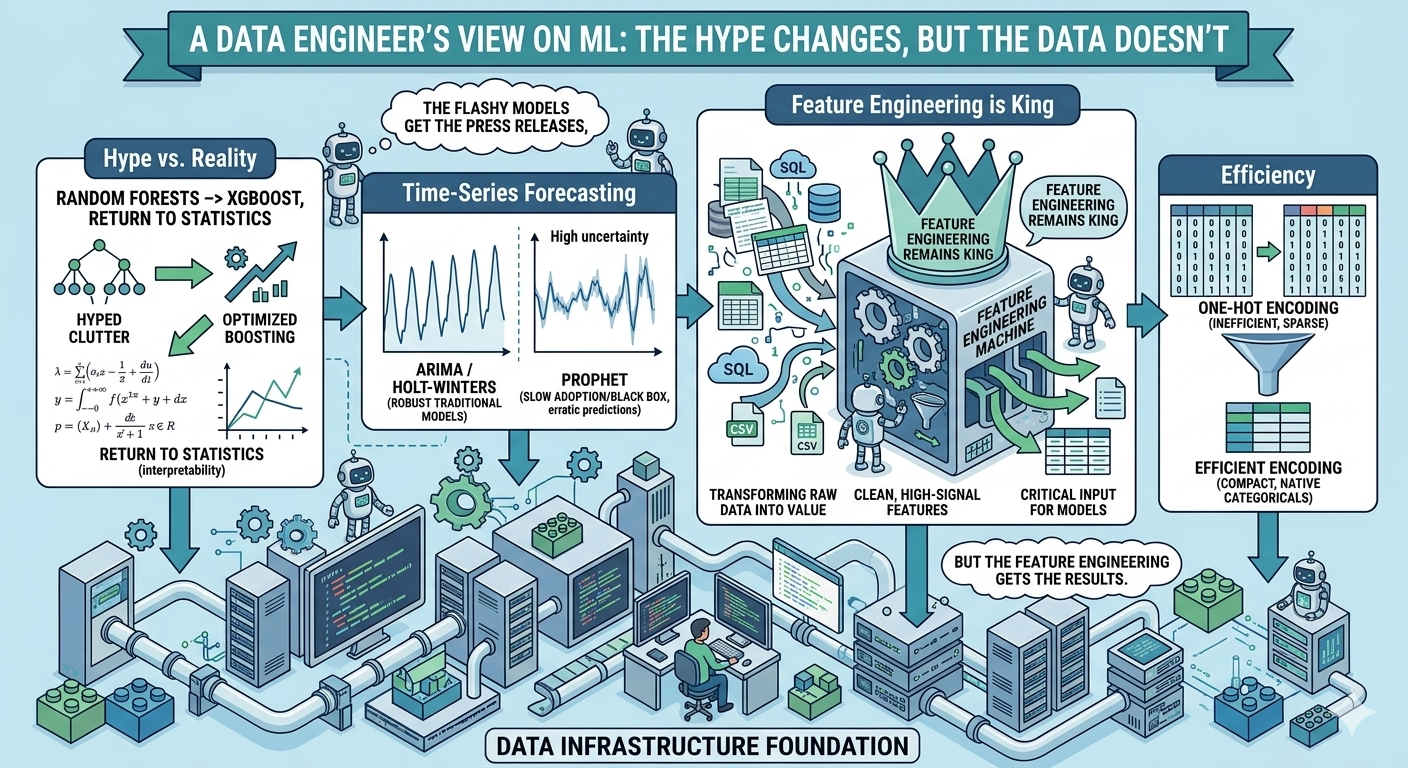
It’s been fascinating to watch the steady shift away from classic Random Forests toward more powerful gradient boosting frameworks like XGBoost. But what’s even more interesting is our collective resistance to over-engineering.
Despite the tools available to build massively complex, custom deep learning architectures, the industry still heavily relies on robust statistical models. Why? Because they are interpretable, predictable, and they deliver better, more reliable results without the massive compute overhead. We don't need to hardcode a black box when solid statistics get the job done.
2. Time-Series Forecasting: The Resilience of ARIMA and Holt-Winters
There was a time when newer, automated forecasting tools like Facebook’s Prophet were touted as the future of time-series analysis. But if you look at real production environments today, adoption has been incredibly slow—and in many cases, teams are actively reverting to the classics.
When it comes to forecasting, traditional statistical models like ARIMA and Holt-Winters still rule the roost. They are mathematically transparent, highly predictable, and handle seasonality exceptionally well without the erratic behavior that sometimes plagues automated "black box" forecasting tools. Old-school statistics continue to outclass the hype.
3. Feature Engineering is Still King
There is a common misconception that if you throw enough data into a modern AI model, it will magically figure out the patterns itself.
The reality? Feature engineering remains—and will likely always remain—the most important piece of the puzzle. A world-class model cannot fix terrible data or poorly designed features. The real magic isn't happening in the model configuration file; it's happening in the transformation layer where raw data is turned into meaningful, high-signal attributes. Garbage in, garbage out is still the golden rule.
4. Efficiency Over Brute Force: Moving Past One-Hot Encoding
On a purely technical level, it’s great to see the industry moving away from naive data preparation approaches like massive One-Hot Encoding. Transforming categorical variables into hundreds of sparse binary columns was always an inefficient way to handle data at scale.
Modern frameworks handle categorical features much more natively and efficiently now. We are optimizing how data is represented under the hood, which saves memory, speeds up training, and lowers the cloud bill.
The Takeaway: Infrastructure Wins
You can change the algorithm, swap the framework, or scale the cluster, but you cannot out-engineer bad data components. Even in the age of generative AI and massive LLMs, the data engineer's role in shaping, cleaning, and engineering features is what actually keeps the machine running.
The flashy models get the press releases, but the feature engineering gets the results.
Comments (0)
No comments yet. Be the first to share your thoughts!