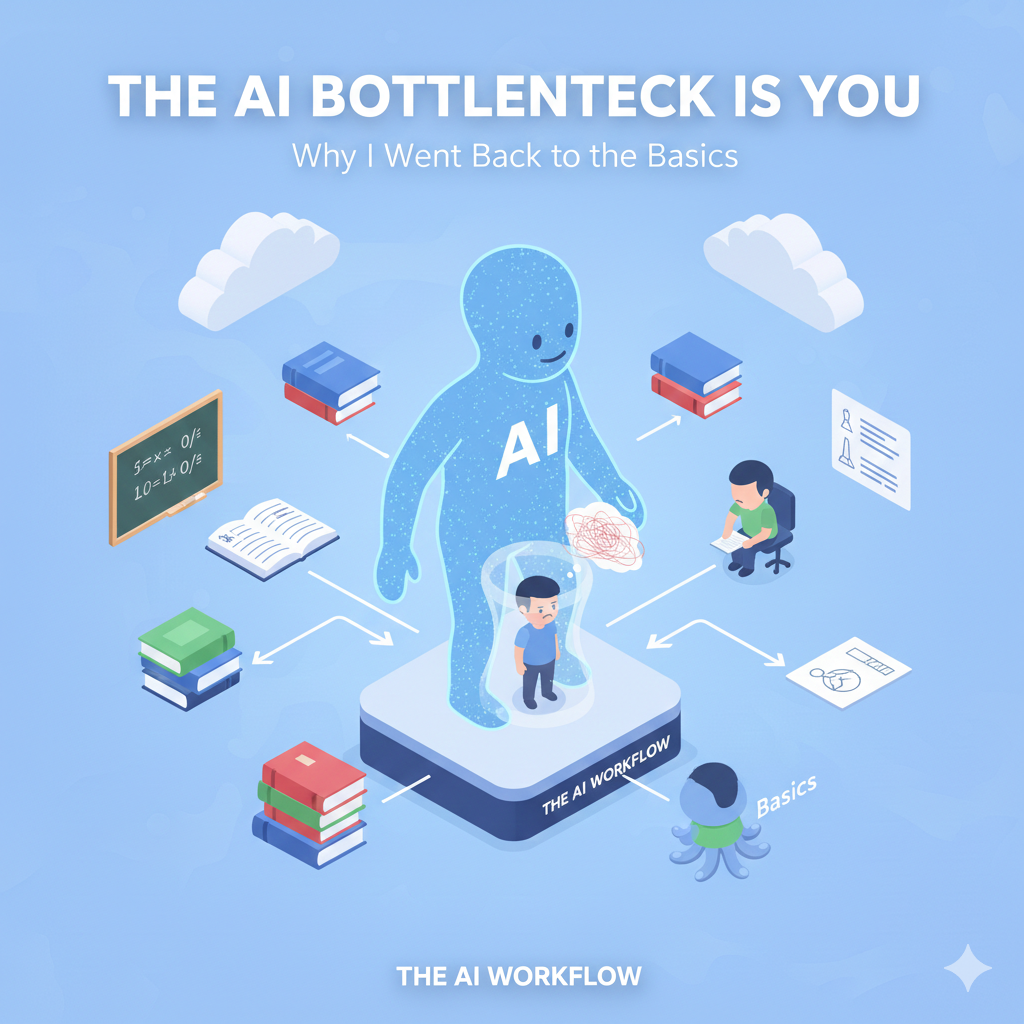
The AI Bottlneck Is You: Why I Went Back To The Basics
Welcome to a new section of the blog: Personal Development.
Usually, I use this space to talk about the technical side of building a business—data pipelines, server configurations, and automation. But lately, I’ve realized that the most important piece of hardware I need to upgrade isn't sitting on a server rack. It’s me.
We are living in the golden age of Artificial Intelligence. Tools like Gemini can synthesize complex problems and spit out brilliant code or business strategies in seconds. But as I integrated these tools into my daily workflow, I noticed a glaring issue: I was the bottleneck.
The machine can generate an answer in three seconds. But if it takes me three minutes to hunt-and-peck the perfect prompt, and another ten minutes to read the output, I’m not actually maximizing the technology.
I developed a theory: To truly unlock the power of modern AI, we have to aggressively upgrade our most basic, foundational skills.
Sometimes, to move forward, you have to go all the way back to the basics. Here are the three personal milestones I’ve been tackling to keep up with the machines.
1. Faster Input: Rewiring My Brain with Dvorak
Typing is the primary way we communicate with AI right now. If your hands can't keep up with your brain, you lose your train of thought.
Instead of just trying to type faster on the standard keyboard I've used for over a decade in the IT industry, I decided to completely tear down my foundation and learn the Dvorak keyboard layout.
Let me tell you, there is nothing more humbling than being a seasoned professional and suddenly having to track your daily typing speed and accuracy metrics like a grade-schooler learning the home row. It was painful at first, and my words per minute plummeted. But by going back to the absolute basics of muscle memory, I'm building a system designed for speed and efficiency, significantly reducing the friction between my thoughts and the prompt box.
2. Faster Output Processing: The Art of Speed Reading
If typing is how we talk to AI, reading is how we listen. When an LLM generates a massive, insightful block of text, slowly reading it word-by-word kills your momentum.
I started actively practicing speed reading. The biggest game-changer for me was learning to stop reading individual words and start reading in chunks.
By training my eyes to take in groups of three or four words at a glance, my reading speed skyrocketed. More surprisingly, my comprehension actually improved. When you read in chunks, you process concepts and ideas rather than getting bogged down in the syllables. I can now parse an AI's output, extract the value, and move on to the next task in a fraction of the time.
3. Better Retention: Upgrading the Hard Drive (Memory)
What good is reading faster if you don't remember any of it?
AI allows us to consume vast amounts of synthesized knowledge across different domains. To make that knowledge useful, it has to stick. Improving my memory has become the third pillar of this journey. It’s not just about raw recall; it’s about utilizing spatial memory techniques—like building memory palaces or structuring concepts through mind mapping—to organize all this new information.
Whether I'm absorbing a new technical concept or studying for my next cloud certification, if I can read it fast, I need to file it away just as quickly so I can connect the dots later.
The Takeaway
It feels counterintuitive. In an era where machines can do almost anything, I am spending my time practicing typing, reading, and memorizing—skills I technically "finished" learning in elementary school.
But if you want to leverage the tools of the future, you have to ensure the operator is running on the best possible software. Sometimes, the only way to leap forward is to take a few steps back to the basics.
What foundational skills have you revisited lately? Let me know!
Comments (0)
No comments yet. Be the first to share your thoughts!